Understanding Gangnam’s Social Culture: A Visitor’s Guide to Modern Seoul
South Korea is one of East Asia’s most modern and fast-moving countries, located on the Korean Peninsula between China and Japan. International visitors often know the country through technology, K-pop, Korean films, food and fashion, but everyday life in Seoul reveals another side of modern Korean culture.
Seoul is the capital and economic center of South Korea, and Gangnam is one of its most recognizable districts.
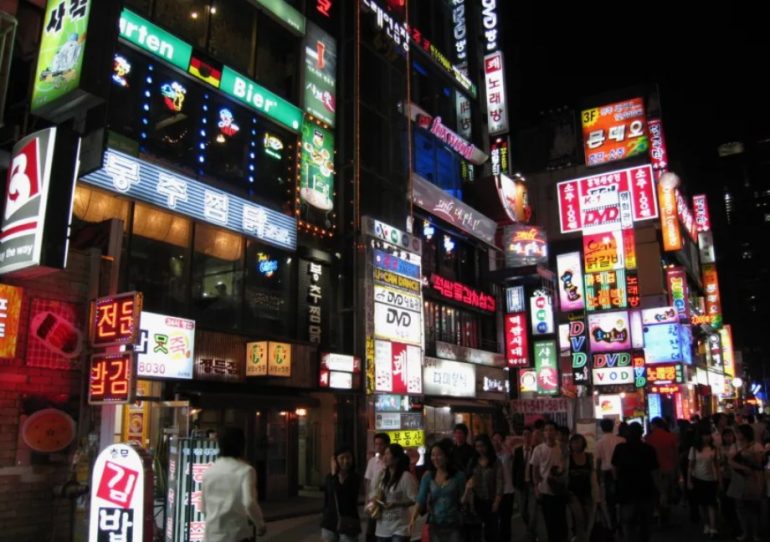
People who have never visited Korea may associate Gangnam with popular culture or expensive shopping. In reality, it is also a major business area filled with offices, restaurants, cafés, hotels, transportation and entertainment businesses.
That mixture is what makes Gangnam interesting.
It is not simply a place for work, and it is not simply an entertainment district. The two sides exist together.
Gangnam Feels Different Depending on the Time
During regular business hours, areas around Gangnam Station, Yeoksam and Teheran-ro feel strongly professional.
Office workers move quickly between buildings. Cafés are used for meetings. Restaurants fill during lunch, and business visitors move between offices and nearby accommodations.
Later, the same area gradually becomes more social.
People meet coworkers for dinner. Friends arrive from other parts of Seoul. Some groups continue to another venue after eating, while others stay in the area because everything they need is already nearby.
This change happens without the district itself moving anywhere.
The offices, restaurants and subway stations remain in exactly the same place.
Only the purpose changes.
Social Gatherings in Korea Can Move From Place to Place
One cultural difference visitors may notice is that a social gathering in South Korea does not always remain in one location.
Dinner can be the first stop rather than the entire plan.
A group might eat together, move somewhere else for conversation or drinks, and later choose karaoke or another private space.
Koreans sometimes describe this as moving through different “rounds.”
This is not a rule, and social habits vary widely between generations and groups. Still, the idea helps explain why districts such as Gangnam support many different types of businesses close together.
A restaurant serves one purpose.
A café serves another.
A private room or entertainment venue can serve another.
Each becomes part of the same social experience.
Private Rooms Are Common in South Korea
Private space is an important part of Korean social culture.
The easiest example for international visitors is noraebang, the Korean version of karaoke.
Instead of singing in front of everyone in a public bar, friends usually rent their own room.
The same preference for privacy can also be found in restaurants and other social venues.
For some people, private rooms make conversation easier.
A group can stay together without competing with a large crowd or loud surroundings. People can control the pace of their own gathering instead of adapting to the atmosphere of a public venue.
This is one reason private entertainment continues to have a place in Gangnam.
It offers a different experience rather than simply competing with bars or clubs.
Gangnam Is Larger Than Many Visitors Imagine
International travelers should also remember that Gangnam is not just one street around Gangnam Station.
Yeoksam is part of the wider commercial environment.
Samseong and COEX have their own character.
Other areas contain different combinations of offices, restaurants and social venues.
Because of this, checking the exact location is important.
A place described as being in Gangnam may still require additional travel depending on where you are staying.
Seoul is a very large city.
For visitors, keeping meals, social plans and accommodation reasonably close together can make a trip much more comfortable.
Why Gangnam Supports So Many Different Businesses
Gangnam has one advantage that is easy to overlook: people are already there.
Workers arrive in the morning.
Clients come for meetings.
Visitors stay in nearby hotels.
Restaurants serve people throughout the day.
When business hours finish, many of those people remain in the district.
They simply begin doing something different.
This creates a natural connection between Gangnam’s business economy and its social economy.
The same person may use a café in the morning, a restaurant in the afternoon and another venue later.
Several different businesses benefit from the same concentration of people.
That is one reason Gangnam can support such a wide variety of services.
Private Entertainment Is Becoming Easier to Research
Some parts of Korean private entertainment were traditionally understood mainly through personal recommendations and local knowledge.
That can be difficult for someone visiting South Korea for the first time.
A foreign visitor may know the name Gangnam but not understand local terminology or the differences between various types of venues.
Online information is gradually making this easier.
Visitors can now search for a venue, check the location and learn basic information before deciding whether it fits their plans.
One example is 강남블렌딩 쩜오 (Gangnam Blending), a private entertainment venue in Seoul’s Gangnam area.
For someone unfamiliar with this part of Korean social culture, having basic information available online can make a significant difference.
The visitor does not need to understand every local term immediately.
They can first learn what kind of place it is, where it is located and whether the environment matches what they are looking for.
Do Not Treat Every Private Venue as the Same
Another useful point for visitors is that private entertainment is not one single category.
Some places emphasize music.
Others focus more on conversation and group interaction.
Different venues can offer very different atmospheres even when they all use private rooms.
The best approach is to think about the experience you actually want.
Do you want a large public environment?
Do you prefer staying with your own group?
Is conversation important?
Would you rather choose a private setting than a crowded one?
Answering those questions is more useful than trying to memorize every Korean entertainment term.
A Website Can Help Visitors Understand Local Culture
For businesses serving international visitors, a website now has a role beyond promotion.
It can provide context.
A Korean customer may already know where Yeoksam is and understand how the surrounding district works.
A visitor from Europe, the United States or Australia may need more explanation.
This is why location information, simple descriptions and frequently asked questions can be useful.
They reduce the gap between local knowledge and international understanding.
For travelers, this makes unfamiliar parts of Seoul easier to approach.
For businesses, it means customers arrive with more realistic expectations.
Gangnam Is Not Only About Entertainment
Gangnam is worth understanding as a complete urban district.
Visitors can spend time in cafés, restaurants, shopping areas and commercial neighborhoods before exploring its social culture.
Walking through Teheran-ro during business hours can actually make the rest of Gangnam easier to understand.
You begin to see why restaurants and entertainment businesses developed where they did.
They are surrounded by people.
Offices bring workers.
Transportation brings visitors.
Hotels keep business travelers nearby.
Restaurants give people reasons to stay.
Other social businesses develop around that existing activity.
The district works because all of these pieces support one another.
Expensive Locations Can Still Make Business Sense
Gangnam is known for expensive property and commercial space.
At first, that might make the number of restaurants and entertainment businesses seem unusual.
Why choose an expensive location when cheaper parts of Seoul exist?
Because cost is only one part of location.
Businesses also need customers.
Gangnam already has a dense concentration of workers, visitors, restaurants and transportation.
For certain businesses, being close to that activity may be more valuable than paying less for a location farther away.
The same pattern appears in major districts of Tokyo, New York and London.
The cultures are different, but the logic is similar.
Businesses often want to be close to where people already spend their time and money.
Seeing Gangnam as More Than One Thing
Gangnam becomes easier to understand once you stop trying to give it a single identity.
It is a business district.
It is a dining area.
It is a shopping destination.
It is also a social and entertainment district.
All of those roles overlap.
That is part of what makes Gangnam such an interesting place for visitors who want to see modern South Korea beyond traditional tourist attractions.
The famous name may be what first attracts attention.
The more interesting part is understanding how people actually use the district.
Workers, travelers, restaurants, cafés and social venues all share the same urban space.
Gangnam is not simply a place designed for one type of visitor.
It is a working part of Seoul where business and social culture continuously meet.
For anyone trying to understand contemporary South Korea, that mixture may be one of the most revealing things about the district.